
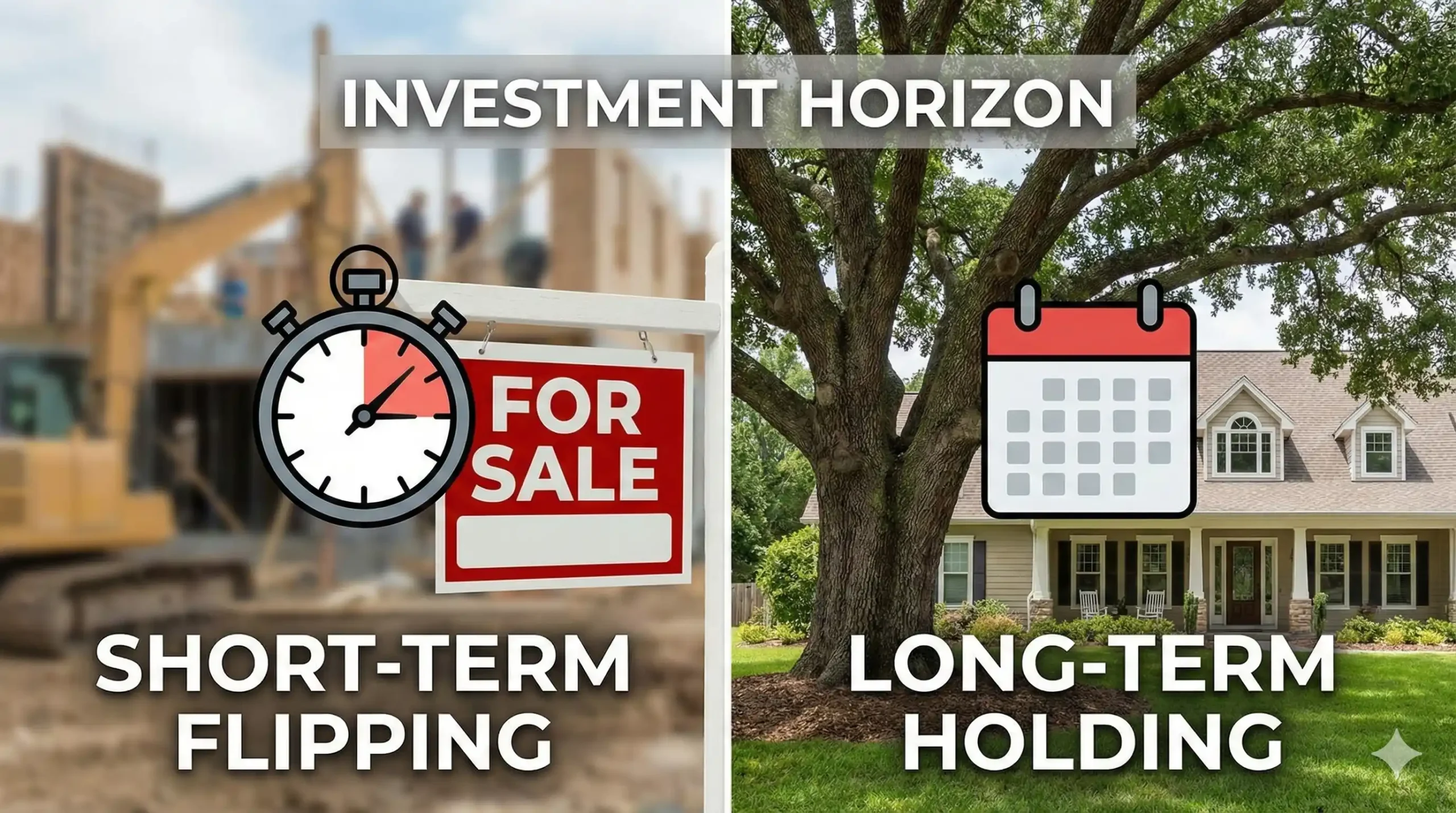
Real estate investment is not only about choosing the right project. It is also about choosing the right timeline. Many people lose money or get stuck because they invest with a short-term mindset in a market that needs patience, or they lock money long-term when they actually need liquidity.
This blog will help you decide whether short-term flipping or long-term holding suits you, what returns are realistic, what risks are hidden, and how to pick the right strategy based on your situation.
First, be clear on what you actually want
Before you choose a strategy, answer this honestly:
Do you want quick cash growth, or do you want stable wealth building?
Short-term flipping aims for faster profit but comes with higher uncertainty and market timing risk. Long-term holding aims for slower growth but usually has more stability and more time to recover from market cycles.
What is short-term flipping?
Short-term flipping means buying a property, file, plot, or sometimes a unit, and selling it within a limited period such as a few months to one or two years. The goal is to profit from a price jump caused by demand spikes, development milestones, or market hype.
Why flipping can work
- Flipping works when one or more of these happen:
- Launch pricing is significantly lower than later market price
- Balloting results create stronger demand for certain plots
- Possession or development progress increases buyer confidence
- A major access improvement makes the location suddenly attractive
- Overall market sentiment improves and liquidity increases
Where flipping fails most often
- Flipping fails when:
- Demand dries up and buyers vanish
- The market shifts from seller market to buyer market
- Project timelines slip and expected milestones do not happen
- Dues, development charges, or transfer issues reduce profit
- Investors overpay after hype and have no margin left
Flipping needs timing. If you miss timing, you do not just earn less. You may get stuck.
What is long-term holding?
Long-term holding means buying and keeping the asset for multiple years, usually three to ten years or more. The goal is to benefit from gradual development, area maturity, infrastructure growth, and population shift toward that location.
Long-term investors focus less on quick price jumps and more on the overall story of the location and the developer execution.
Why holding can work
- Holding works because:
- Cities expand outward over time
- Infrastructure improves gradually, not instantly
- Societies mature and become livable, increasing end-user demand
- Commercial activity grows, raising land utility and rents
- Market cycles eventually favor patient investors
Where holding fails most often
- Holding fails when:
- The investor chooses a weak location with no real growth drivers
- The project stays stagnant for years due to poor execution
- Documentation or approvals become complicated
- Restrictions and new costs reduce buyer interest
- The investor needs money urgently and sells at a discount
Holding requires patience and stable finances. If you might need cash soon, holding can turn into stress.
The real difference is liquidity
Short-term profit depends on liquidity. You need active buyers at the time you want to sell.
Long-term profit depends on fundamentals. You rely on growth, development, and time.
So ask yourself:
When I need to sell, will there be buyers?
That one question can save you from a bad strategy.
Which strategy suits who?
Short-term flipping suits you if
- You can handle uncertainty and delays
- You have extra cash and do not depend on this money soon
- You track market prices, dealer activity, and demand trends
- You can exit quickly if profit appears
- You understand transfer costs, dues, and margins
Flipping is a business-like approach. It needs active management.
Long-term holding suits you if
- You want wealth building without constant monitoring
- You can keep the asset through market slowdowns
- You are investing based on location expansion and development
- You prefer end-user driven markets rather than investor hype only
- You want lower stress and fewer transactions
Holding is a patience-based approach. It needs discipline.
The most common mistake: using the wrong horizon for the wrong asset
Not every property type fits flipping or holding equally.
Files and early-stage bookings
Often traded in investor markets. These can suit flipping if liquidity is strong. But they are more sensitive to rumors, policy changes, and sudden slowdowns.
Plots in partially developed societies
Can work for both. Flipping can work around balloting or possession milestones. Holding can work if the location has strong long-term demand.
Ready houses and apartments
Better for holding, especially if rental demand exists. Flipping is harder unless the market is booming or the unit is bought below market value.
Commercial plots
High upside but higher volatility. They can suit holding in strong corridors or flipping in high-demand phases, but risk is higher.
Return expectations: be realistic
People often expect every property to double quickly. That is not realistic in most cycles.
Short-term flipping can generate strong returns when liquidity is hot, but it can also produce almost nothing after costs if the market slows.
Long-term holding often produces steadier results, but it requires time. It is not exciting, but it is often safer.
- The smarter approach is to focus on net return after:
- Transfer fees and taxes
- Development charges and dues
- Dealer commissions
- Holding time and opportunity cost
Profit that looks big on paper can shrink after these costs.
A simple decision framework you can use
Use this framework before buying any property:
Step 1: Decide your money timeline
If you might need funds within 12 to 24 months, do not choose a long horizon asset.
Step 2: Check demand type
If demand is mostly investors, flipping may work but risk is higher.
If demand includes end-users, holding is usually safer.
Step 3: Identify the catalyst
For flipping, ask: what event will raise price soon?
For holding, ask: what long-term drivers will grow this area?
If you cannot answer this clearly, do not buy.
Step 4: Plan your exit before entry
Set a realistic selling range and a maximum holding time. If the plan fails, you should already know what you will do next.
Hybrid strategy: the approach most serious investors use
Many smart investors combine both:
They flip a portion of holdings when the market gives easy profit, and keep the strongest asset for long-term wealth building.
This reduces stress because you secure some gains while still staying positioned for long-term growth.
Final thoughts
Short-term flipping can suit you if you have time, market understanding, and risk tolerance. Long-term holding can suit you if you want stable wealth building and can stay patient through slow phases.
Your best strategy is the one that matches your cash needs, risk tolerance, and the reality of your chosen project. Real estate rewards discipline more than excitement.
If you want, tell me what you are planning to buy, such as file, plot, house, or apartment, and your expected holding period, and I will suggest which horizon fits better and what to check before you invest.