If you are buying a plot, file, house, or commercial unit in Pakistan, you will hear one word again and again: NOC. Many buyers treat it like a formality, and many sellers use it as a marketing line. In reality, NOC status can affect everything from resale demand to utilities to legal risk.
This blog explains what an NOC is in simple terms, why it matters, common misunderstandings, and how you can verify claims before you pay.
What is an NOC?
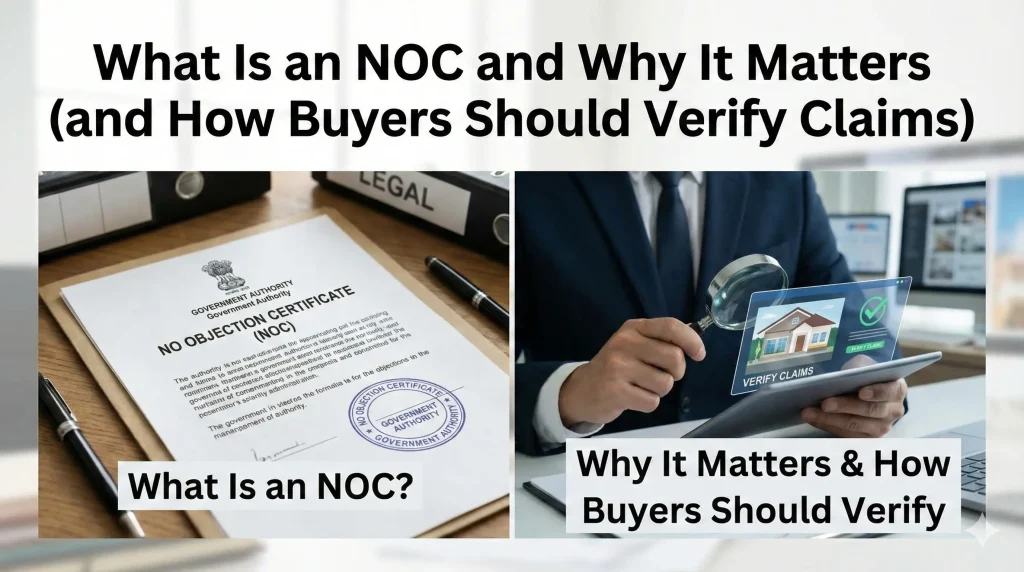
NOC means No Objection Certificate. In real estate, it generally refers to an approval or clearance issued by a relevant authority that allows a housing society or development to be marketed, developed, or sold under certain conditions.
Think of it like this: an NOC is the authority saying, “We do not object to this project moving forward, based on the information and requirements submitted.”
Important detail: Different regions and project types can involve different authorities. An NOC is not a single universal certificate for all of Pakistan. It depends on the location and jurisdiction.
Why NOC matters in real-world buying
1) It reduces legal and regulatory risk
When a society lacks required approvals, buyers can face uncertainty like restrictions on sales, transfers, or development activity. Even if nothing happens immediately, risk stays attached to the asset, and that affects value.
2) It affects resale and liquidity
Most experienced buyers and investors ask about NOC early. If the status is unclear, many simply avoid the deal. That means fewer buyers in the market when you want to sell, which can force you into discounting.
3) It can impact utilities and infrastructure
In many cases, formal approvals influence how smoothly utilities and services move forward. Even when utilities are available through other arrangements, approved projects usually have a clearer path to stable long-term services.
4) It protects you from “marketing-only” projects
Some projects sell aggressively based on maps, promises, and future claims. NOC verification is one of the fastest ways to separate serious developments from risky ones.
What an NOC does not guarantee
This is where many buyers get confused.
- An NOC does not automatically mean:
- The project will deliver on time
- Every block will be developed equally
- You will get possession quickly
- Prices will rise
- There is no financial risk
NOC reduces one major category of risk, but it does not remove construction delays, market cycles, or developer execution risk.
Common NOC tricks and misunderstandings
Claim 1: “NOC is approved” without showing proof
Many sellers say this verbally. That is not enough. If they cannot provide a verifiable reference, treat it as unconfirmed.
Claim 2: “NOC is in process” used as a permanent excuse
“In process” can mean anything. It could be near completion, or it could be nowhere. Buyers should treat “in process” projects as higher risk unless they can confirm progress through reliable channels.
Claim 3: Partial approvals presented like full approval
Sometimes a parent project or an earlier phase has approvals while a new extension, phase, or specific block is still not cleared. Marketing often blends these together. You must confirm your exact phase and area.
Claim 4: Old documents shown as current status
Even if a document is real, it might not reflect the latest standing. Status can change, conditions can be added, or permissions can expire or be revised.
How buyers should verify NOC claims
You do not need to be a lawyer to do basic verification. You just need a method.
Step 1: Ask for the exact project identity
- Before checking anything, get clarity on:
- Project name exactly as marketed
- Phase name and block name
- Developer or management company name
- Location and jurisdiction
This matters because many names sound similar. Verification fails when people check the wrong entity.
Step 2: Ask for proof that can be cross-checked
- Request at least one of the following:
- A copy of the NOC or approval letter showing authority name, project name, and reference number
- A screenshot or print from an official authority listing, if it exists
- A written statement from the developer’s official office with a verifiable reference
If the seller refuses, delays, or becomes emotional, treat that as a warning sign.
Step 3: Verify through official channels
- Do not rely on WhatsApp forwards. Use official sources where possible:
- Relevant development authority websites or official published lists
- Official notices or press releases from the authority
- Visiting the authority office or facilitation center if needed
- Written confirmation through an official contact method
If the authority publishes an updated list of approved societies, your project should appear clearly with the correct name.
Step 4: Confirm the scope of approval
- Even if approval exists, confirm:
- Does it cover the full phase or only a portion?
- Does it include commercial areas, blocks, or only residential?
- Are there conditions attached that affect development or possession?
People lose money by assuming an approval covers everything.
Step 5: Match the claim with on-ground reality
- Approval does not build roads. Visit the site and check:
- Boundary wall and entrance control
- Roads, street development, drainage
- Electricity and water arrangements
- Signs of active work and machinery
A project can claim approvals and still be slow. Your decision should consider both paperwork and execution.
Red flags you should not ignore
- Be cautious if you see these:
- Only verbal claims, no documents
- Conflicting answers from different salespeople
- Pressure to book “today” because “NOC is coming tomorrow”
- Claims that you should not worry because “everyone is buying”
- Documents with unclear names, missing reference numbers, or mismatched project details
High-pressure selling is often used to push buyers past verification.
Practical advice: how to make NOC part of your buying process
Here is a clean sequence that works:
- Decide your budget and goal: living, rental, or resale
- Shortlist 3 to 5 societies
- Verify NOC and approvals for each
- Visit sites and compare development
- Compare prices only after verification
- Book only when paperwork and reality align
If you do this, you will avoid most avoidable losses.
Final thoughts
An NOC matters because it helps you reduce legal uncertainty and protects resale value. But it is not a magic guarantee. Smart buyers treat NOC as one pillar of due diligence, along with documentation, developer track record, development progress, and realistic exit planning.
If you want, tell me the city and the society name you are writing about for your blog, and I can make a more targeted version of this post with a matching checklist and buyer FAQs suitable for your website.